Showing posts with label congress. Show all posts

Thursday, June 30, 2016

Why We Should Put An End to The Draft

Congress has been debating the merits of adding women into Selective Service to be drafted with men during times of national emergency.

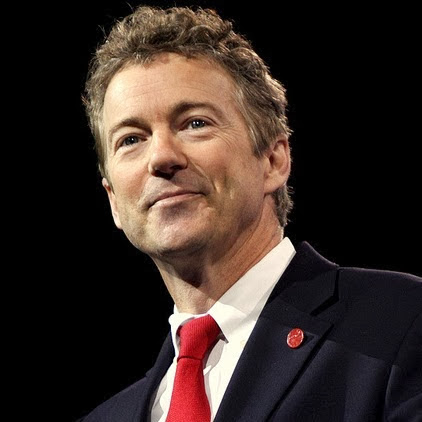
Kentucky's Senator Rand Paul suggests that it would be better to just end the draft.

The Libertarian Party agrees.

"The draft is simply slavery by another name. Drafting people to go abroad and kill or be killed is barbaric and a discredit to our military and country," said Nicholas Sarwark, chair of the Libertarian National Committee.

If a national emergency is so severe to merit mobilizing extra troops, Americans from all backgrounds, ages, and genders should pitch in to do what is needed. However, this should not be forced. It is an insult to the idea of a "free country".

The draft, whether for military purposes or some form of “national service,” violates the basic moral principles of individual liberty upon which this country was founded. Furthermore, the military neither wants nor needs a draft.

Former President Ronald Reagan eloquently expressed the moral case against the draft in the publication Human Events in 1979: “[Conscription] rests on the assumption that your kids belong to the state. If we buy that assumption then it is for the state ­ not for parents, the community, the religious institutions or teachers ­ to decide who shall have what values and who shall do what work, when, where and how in our society. That assumption isn’t a new one. The Nazis thought it was a great idea.”

The Libertarian Party urges elected leaders to end the draft and also to pursue foreign policy which is less dependent on military might. The money we spend annually on our military is a waste, when we have a presence in foreign conflicts.

Economic hardship is great in all wars. War is never economically beneficial except for those in position to profit from war expenditures. The great tragedy of war is that it enables the careless disregard for civil liberties of our own people. Abuses of German and Japanese Americans in World War I and World War II are well known.

The real sacrifice comes with conscription ­forcing a small number of young citizens to fight the wars that older men and women promote. It's easy to promote a war for your own glory when you aren't the one being shot at. The draft encourages wars with neither purpose nor moral justification, wars that too often are not even declared by the Congress.
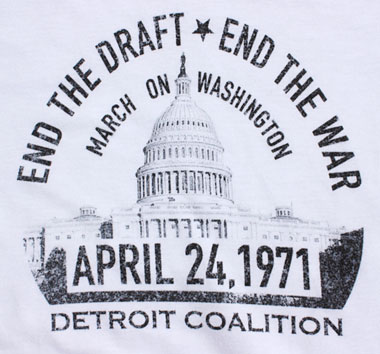
Without conscription, unpopular wars are difficult to fight. The Vietnam War came to an end quickly
after the draft was undermined. Most importantly, liberty cannot be preserved by tyranny. A free society must always resort to volunteers. Tyrants think nothing of forcing men to fight and serve in wrongheaded wars. A true fight for survival and defense of America would elicit the defense of those who love her. This is not the case with wars of mischief far away from home, which we have experienced often in the past century.

The United States has many tools of foreign policy at our disposal that do not require force. Military force should always be a last resort and only in defense.

The Libertarian Party is the only political party in America devoted to protecting all rights, of all human beings, all the time. The Libertarian Party also strongly condemns the use of force except in self defense.

Friday, June 24, 2016

Why You Need To Understand The Electoral College

It's come to my attention recently that many of my friends don't seem to understand how voting WORKS. Which is terrifying, since most of them are voters. It appears a little elementary school history lesson is in order.

Here's the thing. You don't choose who the next president is going to be. None of us do. Our votes "count" but not if the electoral college disagrees. (The electoral college is a process btw NOT a place) The founding fathers established it in the Constitution as a compromise between election of the President by a vote in Congress and election of the President by a popular vote of qualified citizens.

So here's how the electoral college currently operates:


  • Each State is allocated a number of Electors equal to the number of its U.S. Senators (always 2) plus the number of its U.S. Representatives (which may change each decade according to the size of each State's population as determined in the Census).
  • The political parties (or independent candidates) in each State submit to the State's chief election official a list of individuals pledged to their candidate for president and equal in number to the State's electoral vote. Usually, the major political parties select these individuals in their State party conventions while third parties and independent candidates merely designate theirs.
  • Members of Congress and employees of the federal government are prohibited from serving as an Elector in order to maintain the balance between the legislative and executive branches of the federal government.
  • After their caucuses and primaries, the major parties nominate their candidates for president and vice president in their national conventions - traditionally held in the summer preceding the election. (Third parties and independent candidates follow different procedures according to the individual State laws). The names of the duly nominated candidates are then officially submitted to each State's chief election official so that they might appear on the general election ballot.
  • On the Tuesday following the first Monday of November in years divisible by four, the people in each State cast their ballots for the party slate of Electors representing their choice for president and vice president (although as a matter of practice, general election ballots normally say "Electors for" each set of candidates rather than list the individual Electors on each slate).
  • Whichever party slate wins the most popular votes in the State becomes that State's Electors - so that, in effect, whichever presidential ticket gets the most popular votes in a State wins all the Electors of that State. (The two exceptions to this are Maine and Nebraska where two Electors are chosen by a statewide popular vote and remainder by the popular vote within each Congressional district).
  • On the Monday following the second Wednesday of December (as established in federal law) each State's Electors meet in their respective State capitals and cast their electoral votes - one for president and one for vice president.
  • In order to prevent Electors from voting only for "favorite sons" of their home State, at least one of their votes must be for a person from outside their State (though this is seldom a problem since the parties have consistently nominated presidential and vice presidential candidate from different States).
  • The electoral votes are then sealed and transmitted from each State to the President of the Senate who, on the following January 6, opens and reads them before both houses of the Congress.
  • The candidate for president with the most electoral votes, provided that it is an absolute majority (one over half of the total), is declared president. Similarly, the vice presidential candidate with the absolute majority of electoral votes is declared vice president.
  • In the event that no one obtains an absolute majority of electoral votes for president, the U.S. House of Representatives (as the chamber closest to the people) selects the president from among the top three contenders with each State casting only one vote and an absolute majority of the States being required to elect. Similarly, if no one obtains an absolute majority for vice president, then the U.S. Senate makes the selection from among the top two contenders for that office.
If you're still confused, you can learn more here.